Scoped permissions, enforced policies, and unified payment rails for Ethereum agents.
ExecutionContext, policy engine at the tool layer, and a unified x402 + MPP payment rail — packaged as a TypeScript SDK.
Integrated with
The execution infrastructure agents are missing.
Structured intent routing, policy enforcement at the call layer, and unified payment rails — so agents can act safely and verifiably on Ethereum.
// Payment Rails
Unified x402 + MPP payment abstraction
One SDK primitive abstracts x402 crypto micropayments, MPP web2 rails, and onchain gas. The runtime selects the right rail per action transparently — no manual wiring.

// Policy Engine
Enforcement at the tool layer, not spawn time
OPA-style rules evaluated at every tool call. Actions are risk-tiered — LOW auto-executes, CRITICAL requires passkey sign. Prompt injection can't bypass it because the constraint lives in the execution layer.

// Intent Taxonomy
Deterministic routing across 20+ intent classes
A structured schema of Ethereum retail intents — from simple swaps to multi-agent LP rebalancing — each mapped to params, protocol templates, risk tier, and payment rails. No hallucinated tool calls.

From intent to on-chain execution.
Every agent action flows through intent classification, scoped context, policy enforcement, and verified execution — in that order.
- 1
Classify intent
User intent is parsed into a structured class — swap, liquidity, send, rebalance — with extracted params, risk tier, and protocol rails.
- 2
Scoped execution context
Each agent run gets a passkey-bound, TTL-limited ExecutionContext. Sub-agents can only narrow scope — never expand it.
- 3
Policy check at the tool layer
Every tool call is evaluated against OPA rules before execution. HIGH and CRITICAL actions require explicit confirmation or passkey sign.
- 4
Execute and verify
Action routes through the correct protocol template. Every step is signed, logged, and anchored on-chain.
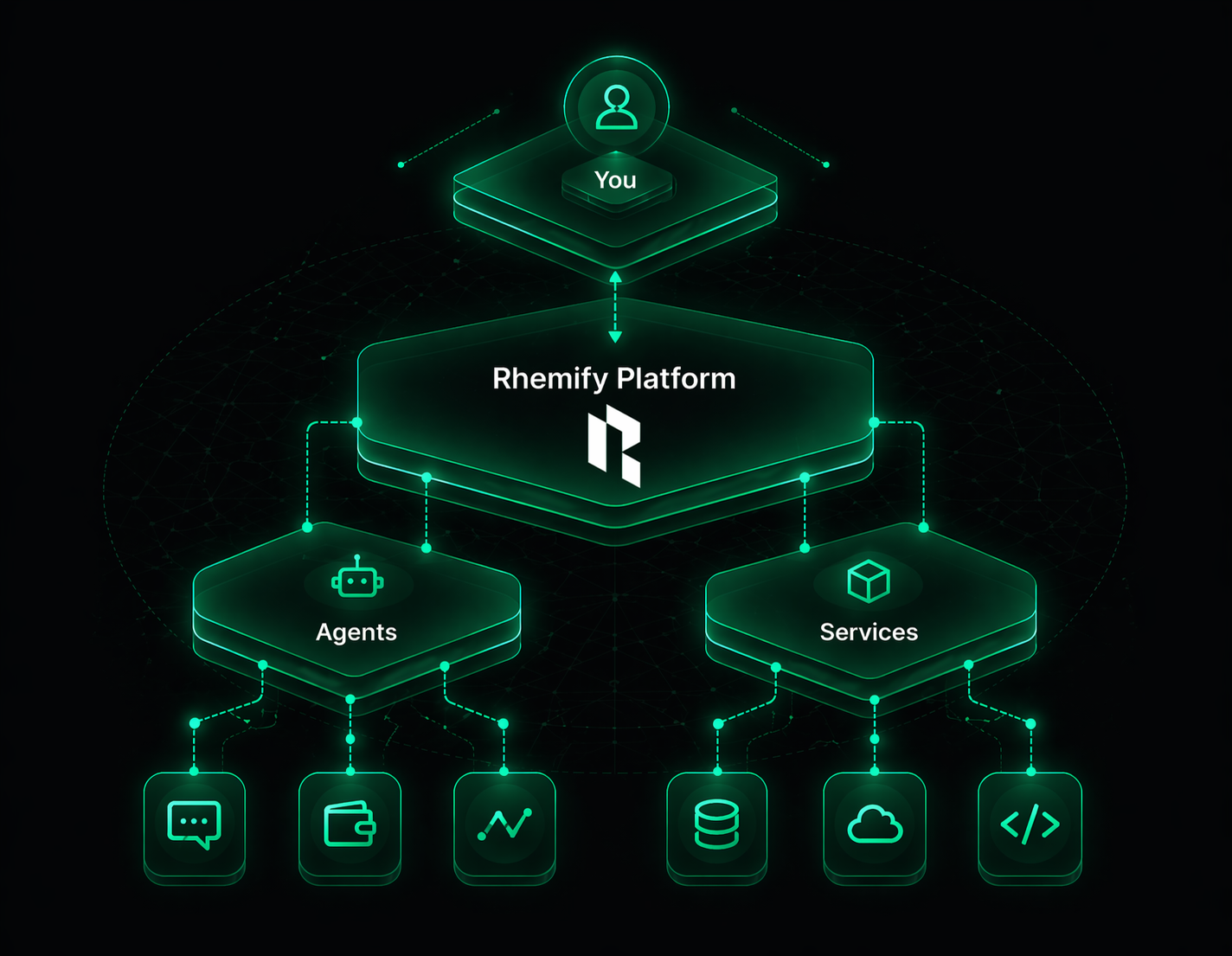
However you build
Ship agents that execute on Ethereum — safely, out of the box.
The SDK handles scoped contexts, policy enforcement, and payment rails. You define the intents and risk tiers. Agents do the rest with guardrails built in.
Plans made for every agent fleet
Start with a free CEO agent and two departments. Scale to unlimited agents with full spend policies when you're ready.
Free
$0 /monthKick the tires with a single CEO agent and two departments.
- CEO agent always included
- 2 department agents
- Real-time transaction feed
- Basic spend guardrails
- Community support
Pro
$9 /agent /monthFor teams running production agent fleets with full delegation.
- Unlimited agents & departments
- Per-agent spend policies
- Multi-chain payments
- Approved vendors & daily limits
- Agent-to-agent delegation
- SDK access
- Real-time audit logs
- Auto-freeze on policy breach
- Priority support
- Only active agents are billed

Partner with us